Showing posts with label Dming. Show all posts

Tuesday, March 21, 2023

Megadungeon DM Overview

As I have said before, running a megadungeon is fundamentally different than running other types of campaigns. As such, it must be approached differently than a city adventure or a story driven location campaign. Let's look at how best to facilitate the megadungeon in play.

1. Choose a system that works best for the environment. 
  • Combat needs to be quick (you may have 7-8 in a 4 hour session). In a modern game, this can be difficult. Don't let players debate during combat. They should have a plan before swords are swung. At first, keep them aware they must move quickly, and by session 3, impose a turn time limit (1 minute?)
    In OSR games, the rules facilitate the quick movement of combat. Still, letting them make a detailed plan while monsters are attacking with halitosis breath may not be the best time. Keep them moving.
  • Using a skill system needs to be handled with care. If you use a game with a robust skill system, bonuses should be given for good description: "I search for traps" should be a Investigation check with no bonuses, while "I lead the party slowly ahead, rolling ball bearings down the hallway then prodding for pit traps with the 10 ft. pole." should garner a +2 or better bonus to the roll. Always give good description a reward. The players quickly realize the description matters.
  • Healing needs to be a resource. Giving all HP back for resting makes it difficult to pressure the players to leave the dungeon. In a modern game, I would change the mechanic to 2x level HP are healed upon long rest.
  • XP should always be used for leveling. Milestone XP does not work because it removes player agency. It should be feasible for the party to reach levels 3-4 on the first floor of the dungeon (even if it is slightly boring). This should be feasible on any level. Milestone leveling also squashes exploration. Why go exploring when there is not a reward? (Also, if playing 5E find the 3.5 XP tables and use those for your characters).
  • Know how to handle Save or Die. In modern games, this is problematic because character creation is a time consuming process. Instead, use a system like Exhaustion in the modern games. But, hit them hard with it. Make them feel the repercussions of that failed save. (Also, have them make 2 characters at session 0, so another is ready to go).
  • I DM best in OSR style games: Swords & Wizardry, OSE, BECMI and the like. Knowing where my strength is, I most often choose these. Familiarity is important to keep a game moving, and you should be able to adjudicate quickly. Don't jump into running a megadungeon in a game that you are unfamiliar with. 
2. Understand how megadungeons work mechanically. They use some tropes over and over again.
  • Exploration is the primary motivation within a megadungeon, and the DM must find ways to motivate the group forward. This could be treasure, a kidnapped NPC, a rival or enemy drawing them forward. Maybe an NPC needs a rare alchemical component from deep within the dungeon to make a cure for the king? Use mcguffins often, but make almost none of them
    The Great
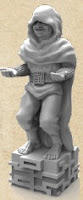
    Winged Gargoyle
    (Barrowmaze)
    necessary
    .
  • Factions are the RP areas of the megadungeon. Often factions are at odds with each other, and the PCs need to choose which one they help. This is probably a lesser of two evils scenario. Let the PCs choose, though.
  • Combat (as mentioned before) needs to be quick. It is noisy and attracts other denizens to grab whatever is weakened (or dead). Keep it moving. Make sure the group knows that more dangers are watching and ready to pounce on the weak.
  • Traps are often deadly. Save or Die is common in megadungeons. 
  • Riddles and puzzles are fun side-bars. They should be noticeable, but not stopping advancement. (The Great Winged Gargoyle in Barrowmaze is a great example of a puzzle that works well). Reward the solutions!
3. Keep the dungeon fresh. If the players think they are just slogging from corridor to corridor and combat to combat, they will get bored quickly.
  • Factions break this up well. Make the NPCs more interesting than NPCs in town. The NPCs in the dungeon have esoteric goals. They are (probably) strange and alien to the group. 
  • Rival adventuring parties can add a pressure to find the mcguffin. Use them to motivate and frustrate the group.
  • Vary combats. Make some rooms have 2-3 (or more) levels to approach and attack. Have skeletons bust out of a wall in the middle of another combat. Make sure wandering monsters show up (and maybe even attack the creatures the PCs are fighting). Have falling walls or debris. Don't let combat be static.
  • Make sure that the group has access to puzzles and riddles. Finding a solution to one of these could be the serotonin dump to keep them motivated. It also gets them to backtrack and discover missed areas.
  • Design levels to be thematically and visually different. A huge cavern of mushrooms with shadows moving just outside of the torchlight is an interesting change to the claustrophobic quarters that led there. Adding a lake makes for interesting choices: cross? find water breathing and explore underneath? Avoid? 
Megadungeons are an art form, and can be painted with any medium. I prefer the OSR brush, but there are a lot of people out there who use the 5E paint set successfully. Even with the differences, we all enjoy stabbing the monsters in the darkness.

Are you enjoying this series? Is there a topic you want me to cover? Let me know, either here in the comments or on Facebook.

Tuesday, March 14, 2023

Exploring With Spells in the Megadungeon

Found at Angry Golem Games
Continuing the thoughts from last week, I thought I would discuss some of the more versatile spells in a megadungeon environment. With literally thousands of spells designed for D&D and its relatives, some are obviously going to be more suited to dungeon environs than others. 

I am using the Labyrinth Lord spell list primarily today. I am not looking at combat (or role playing) applications for the spells, instead, they must be useful within the exploration phase of the game. 

Most "exploration" spells fall into a few broad categories: Blocking, information, movement and resources.

  • Blocking spells protect your flanks (like Arcane Lock)  
  • Information spells give you the ability to make smarter choices (like Light, Commune and Clairvoyance).
  • Movement spells allow access to areas that would be difficult or impossible to reach without them (Fly, Invisibility, Lower Water, and others)
  • Resource spells protect or gather more resources to more efficiently explore the dungeon (Purify Food and Drink, Dispel Magic, Floating Disk).

Clerical Spells
Commune: Any spell that gives you information is useful in a megadungeon. 
Continual Light: Light is possibly the most precious resource in the dungeons. This spell is possibly the best spell that a group can have access to. It is most useful when cast on several object (that can be easily concealed) before entering the dungeon. Even if everyone in the group has darkvision, Continual Light allows for reading script, discerning colors (possibly solving a puzzle or trap)and seeing discoloration (like where a secret door may open). Light  is useful in the same way, but not permanent.
Detect Spells (Evil, Lie, Magic): Information is always useful. When interrogating a prisoner, know if they lie. Detecting evil behind a door may just save a life. And knowing what is magical garners too many benefits to list here. 
Dispel Magic: Too useful in all aspects to ignore. Remove illusions, Arcane Locks, and other hazards with relative ease. 
Find the Path: Know how to get out. Guaranteed.
Find Traps: This name speaks for itself. Don't fall prey to the insidious traps that kill so many adventurers. 
Locate Object: Unless you are close to the exact object you seek, and you have seen it before this spell is less useful than it seems. It is best used to find things like water, food or ways to bypass obstacles (like a lever to raise the portcullis).
Lower Water: With some research and fore-knowledge this spell can grant access to hidden parts of the dungeon. Just do your research before memorizing this one.
Purify Food and Drink: A low level party often has low level resources. This spell stretches those resources, and can often be useful in tempting situations (like walking into a fest-hall with a fully furnished table).
Resist Cold/Fire: These spells allow access to dungeon areas that are difficult to reach without them.
Silence 15' Radius: Most people try to silence spellcasters with this one. Instead, try sneaking past the orc barricades, or that room that drops boulders on your head when any noise is generated. 
Stone Tell: Anything the local stone has seen, it can tell you about? In the right place, this spell can gather more information than any other.
True Seeing: A true get-out-of-jail-free card. Know what is what around the character. Illusions? Pshaw! Secret Doors? Nope. Invisibility? More like no-ability. Once access is gained to this spell, it should always be memorized in a dungeon environment. It has uses in all three pillars of the game (exploration, combat, and role-playing).
Wind Walk: Another spell that allows access to places that were beyond reach. 
Word of Recall: Get-out-of-the-dungeon-free. Sure, your friends probably aren't coming with you, but that's why the Magic-User memorized teleport, right?

As a 1st level cleric, I would enter most megadungeons with Light memorized, with Detect Evil, and Cure Light Wounds as solid options as well. (If I am playing a character with darkvision, that switches to Detect Evil).

As a 5th level cleric, my spell list would be: Detect Evil, CLW, Protection From Evil, Find Traps, Silence 15' radius, and Dispel Magic.

Arcane Spells
Arcane Eye: An information gathering spell that keeps the group (relatively) safe.
Arcane Lock: Make sure nothing is sneaking up on you. Or have a safe resting place. Either way, it is a bargain for a 2nd level spell.
Clairvoyance: Like Arcane Eye a spell that gathers a lot of information at little risk.
Contact Other Plane: Akin to Commune, only take this if the cleric didn't take the other.
Continual Light and Light: See clerical descriptions.
Detect Spells (Evil, Invisible, Magic): Same as the clerical spells. Detect Invisible is less useful in the exploration phase than in combat, but can still see some play (for example a key may be invisible that allows access to a treasure hoard.)
Dispel Magic: covered in the clerical list
Fly: There are often huge drops in caverns and crevasses. Fly makes it easier to navigate.
Hold Portal: Keep the door shut for a couple of hours. Long enough to get away.
Infravision: As has been discussed ad nauseum sight is a primary resource. Infravision may allow for seeing heat radiating from behind a wall or within a chest. Any unexpected heat source should be investigated.
Invisibility, Invisibility 10' Radius: These spells allow bypassing of a potentially dangerous encounter, similar to Silence. Just make sure that you have a plan to get back out.
Levitate: Vertical movement is often the most difficult. Levitate makes those high and low areas more accessible. It may be negated with a rope and grappling hook, though, depending on circumstances.
Limited Wish  and Wish: No brainers. Spells that give you a wish-come-true are useful no matter where you are or what phase of the game you are in.
Locate Object: See clerical version
Lower Water: See clerical version
Magic Jar: This spell can allow unfettered access to areas that are controlled by creatures hostile to the caster. Use it to map out and explore these areas before the assault. Just make sure that your fellows protect you while you are away.
Passwall: Shortcut through the dungeon. It only stays open for 30 minutes, so be quick. But, it can bypass traps, groups of enemies, puzzles, and other hazards.
Phase Door: Similar too Passwall, this spell has the added advantage of being difficult to detect. It has the drawback of being very limited (6-10 uses in total). 
Read Languages, Read Magic: Often while exploring, the party will come across strange glyphs that have information, if they can be deciphered. Having these spells available has the potential to gather a lot of information at little risk.
Telekinesis: Think something is trapped? Use this to manipulate it. Can't get across the portcullis to pull the lever to raise them? TK is your answer. Any time something needs to be manipulated, this spell is potentially useful.
Transmute Rock to Mud: Another shortcut spell. 
Water Breathing: Water features often hide great treasure. Be the one with the ability to recover it.

When entering the megadungeon as a 1st level magic-user, I would prepare Read Languages. First delves almost always come across some writing that will be useful to the group. 

As a 5th level magic-user, my spell list is: Detect Magic, Magic Missile, Arcane Lock, Web, Dispel Magic (unless the cleric has it) or Clairvoyance.

Having the correct spells available for exploring the megadungeon can be the difference between life and death. At the least, using exploration spells allows you to make informed decisions on where, when and how to fight.


Tuesday, January 31, 2023

Megadungeons: Unique Rooms and Encounters

Before beginning, I must state that all artwork used in today's blog is owned by the publishers. I do not claim ownership of any of the art within. I have chosen each piece to represent a part of the topic today. If you find it to your liking, check out the book it is associated with. Links are found within the article.

When designing a megadungeon, a few things will make it stand out as exemplary. First, an evocative name makes it enticing: Barrowmaze, Undermountain, and Rappan Athuk all immediately grab your imagination in different ways. That's your hook.

Second, having a strong theme that pervades levels or even the entire dungeon itself allows the players and DMs to become immersed within. Barrowmaze's undead theme isn't a new one, but Gillespie uses it well to highlight the corruption and dread of the concept.

Finally, having "tentpole" rooms that make your dungeon unique and have people talk about that encounter make the dungeon legendary. Today, I am going to discuss these tentpole rooms. As I read through and review my collection, these are one primary factor in how I view the megadungeon.

Fans of megadungeons know certain places within dungeons that they have never delved: the Font of Snakes in the original Castle Greyhawk, the Well in Rappan Athuk, the Great Chained Doors within the Temple of Elemental Evil are a few examples. Typically, these rooms are a puzzle instead of a combat, although sometimes they are a combat (like the Well) or both (like the Font of Snakes). 

Rappan Athuk's Well

What makes these encounters transcend from a common puzzle to a tentpole, legendary one? Sometimes, it is marketing (like the Well in Rappan Athuk). Other times it is truly a legend from the past (like the Font of Snakes). Others have been played by so many that the location becomes a shared memory (Great Chained Doors).

But, we dungeon masters have one important criterion above all others. It must be fun and interactive. In this, I would like show some shining examples from modern megadungeons.

great winged gargoyle of Barrowmaze
Great Winged Gargoyle
 of Barrowmaze
1. Barrowmaze's Great Winged Gargoyle. When Greg Gillespie released Barrowmaze, he had the forethought to add some artwork from the character's point of view. Largely this is still not done effectively, but Barrowmaze (and his subsequent books) pull it off well. 

The gargoyle itself is a fetch quest, with a decent reward. Simply find and reattach the arm for the prize. This is simple, and the type of puzzle would not typically move the needle for me. But, it is early in the dungeon, so many people who have explored Barrowmaze encountered it. It has great artwork that helps immerse the players in the game.

Dung Monster from Rappan Athuk

2. Rappan Athuk's lair of the Dung Monster is hilarious. A mimic that acts like a bathroom is legendary just based on the concept. Throw in its "unkillable" nature and you have a great encounter. Although it feels like a combat, it is actually a time sink and puzzle. It moves slowly (and can be avoided) but it always reappears when it is inconvenient.

3. The Grande Temple of Jing's Jing Statues. These statues aren't a single encounter. Instead they are pieces of information, puzzles and rewards within the dungeon. Often they have a riddle associated with a particular statue and if answered give a reward. Sometimes it opens a secret area, and others it is wealth or knowledge. Repetition allows the statues to be thought of more frequently, and therefore discussed by groups.

Jing!

Many megadungeons miss the mark when creating a legendary encounter. Most of these become forgotten on the heap of books in my corner. How do we avoid this fate?

These encounters should not be immediately solvable. In the case of the Gargoyle, you must seek out its other part. Dungy cannot be defeated, only foiled. The Jing Statues can be solved, but there's always another one not too far away. The encounter is talked about between sessions. It becomes a driving goal (either short or long term). 

They must be fun. Opening the Great Chained Doors in ToEE causes a whole new level of chaos. It's fun! Dungy slowly creeping up on you while advancing down a deep level of RA is fun. Finding and completing the Gargoyle quest is exciting (and fun). 

These encounters must be almost immediately recognizable as what they are (Dungy being an exception, based on the type of encounter). With all of this in mind, let's look at making an example.

As many of you know, my home dungeon is Mord Mar. It is a dwarven city destroyed by chaos. With that in mind, I begin to design. If your dungeon has its own theme, start there. 

Now, dwarves are famous for mining, making great cities underground, blacksmithing and other tropes. Any of these could be the basis of the encounter. Blacksmithing is calling to me today, however. That gives me the room description: a small forge completely ready to smelt and shape up to the wood and charcoal within the hearth. However, there is no metal to to work within the room. 

Throughout the dungeon, I can sprinkle ingots of different metals for the characters to find. Once the forge is lit, and the ingots are in place the tools then begin working themselves. Depending on what is put inside the forge, different items or hazards can be output (any items are +1 magic):
adamantium = ring of protection
aluminum = small magma elemental attacks
bronze = a jet of liquid metal sprays the room, doing 3d6 (save for half) to everyone inside
copper = a 6-sided die that always rolls 4
iron = helmet
mithril = thieves' tools
steel = dagger

And as I continue to develop the dungeon, I can add more varied materials to allow experimentation. I can add layers (after the 3rd time, a guardian may show up for example). 

Using your own themes, you can develop a fun room too! Just remember:
Don't immediately gratify the players all the time
Make it fun
Make sure it evokes the imagination

And above all, remember that not every room can be legendary! The must punctuate the area or level that they are within. If everything is special, then nothing is.

Tuesday, May 18, 2021

What's wrong with megadungeons?

I ran across a megadungeon article from last July. I know, I am a little behind, as I was dealing with my cancer when it came out.

In the blog, DM David lists 5 reasons why megadungeons don't work for most players.  I have replicated his list here:
1. Players never saw any examples.
2. The ecology and rational of megadungeons seemed ridiculous.
3. Play styles expanded.
4. Megadungons can feel monotonous.
5. Computers do megadungeons better.

Now, I think all of his premises are wrong. Let's start at the beginning:

1. Players never saw any examples.
A few examples were printed through Judges Guild early. Bill Webb and others contend that Tegel Manor is the first printed megadungeon. I lean towards Jennel Jaquays' Caverns of Thracia. There are other examples that people cite too (City-State of the Invincible Overlord's dungeons, the First Fantasy Campaign and probably others too).
The earliest TSR megadungeons didn't come out until the early-mid eighties: Temple of Elemental Evil, and the Lost City (B4).

If you argue that Greyhawk Ruins (first published in 1990) is the first true megadungeon, you could make David's point, but I have listed several examples from the first ten years of D&D that qualify in my expert opinion.

2. The ecology and rational of megadungeons seemed ridiculous.
If any of David's arguments hold weight, it is this one. But, holding to good standards of megadungeon design removes the gravitas. If only 1/3 of the rooms in a dungeon hold combatable creatures, that leaves 2/3 of the space to hold food/resources/restrooms etc. 
In Mord Mar, nearly every dwelling had a mushroom cellar. Rats run amok through the refuse and detritus strewn about by humanoids. They make tasty snacks for goblins. Bats find ways in and out of subterranean structures all the time. 
Rivers dot my megadungeons and when it rains, that water often drips through several levels. It doesn't take much creativity to add a room with a lot of buckets and some dripping water. (We will come back to this idea in #4).

3. Play styles expanded.
I really hate David's exposition on this one. Early D&D was filled with adventures and stories. It wasn't all just "stab the monster and take its stuff." The players used intrigue on each other. They had motivations and ideals and wanted more than David infers. 
I don't think play styles expanded at all. I think most people don't know how to craft a story within a megadungeon. The DM can't handle the possibility that the players may side with orcs, goblins, gnolls or attempt to eradicate all three. 

4. Megadungons can feel monotonous.
Sure, megadungeons can feel monotonous. So can a forest, or a jungle or the miles and miles of desert sand. Any locale will feel boring and stale if the DM can't create excitement in their tone and their words. 
Have your characters ever stood beside an orc raiding party attempting to take control of the water room as the rains started to fall? Maybe they are the diplomatic type and hammer out a solution that each group has a representative doling out water to their compatriots. Maybe the rapscallions seized control of the room and are auctioning water to the highest bidder? Putting good plot hooks in an adventure makes it feel dynamic. Don't blame bad DMing on the megadungeon, 'k?

5. Computers do megadungeons better.
Computers don't do any RPG better, full stop. The computer has certain parameters that need to be followed. That by definition makes them closed-loop games. Unlike D&D and megadungeons, where possibilities are endless. 

And David's concluding line:
"Although good design can yield a megadungeon that proves fun to play, ordinary dungeons can bring the same advantages. Today’s gamers tend to create megadungeons to foster nostalgia or to enable episodic play."

I don't think a smaller dungeon can bring the advantages I look for in a megadungeon. Out of the three tentposts of RPGs (role-play, combat, exploration), exploration is by far my favorite. Sure, I can also explore a forest or a jungle (both of which become repetitive and monotonous quickly) but a megadungeon adds so much more. It adds factions, and hidden rooms and secrets and a history to unearth. 

When you play a well crafted megadungeon, you peel back the layers like an onion, learning new things about the environment. And yes, I also like the episodic play aspect, as I have literally hundreds of friends that play D&D and are all welcome at my table.

Wednesday, April 3, 2019

Trap Tuesday: ToH PT 2

This is the second post on the Tomb of Horrors. The first can be found HERE.

I know it's a day late, and I'm sorry for that. I was surprised at how busy I was with the first 12 hours of the new Kickstarter: Creeping Cold. Now that the obligatory link is out of the way, let's dive back into the Tomb of Horrors. (And again, this blog is full of SPOILERS.)

Backtracking to the Arch of Mist: I mentioned that this can separate parties. It sends incorrect guesses back to the beginning of the module. Following the correct path leads to a puzzle: "The Three Armed Statue." The puzzle has PCs destroy gems in 4 batches.
Destroying these gems once (3 total gems), twice (6 total gems), or thrice (9 total gems) causes nothing to happen.  The 10th gem triggers a Magic Mouth telling the PCs that they have gained something.
So far, I actually like the puzzle. An INVISIBLE Gem of Seeing (really, invisible? after 1000 gp of gems were destroyed? Seems a little much) appears in the severed fourth hand. And the Gem is "immune" to See Invisibility. If the "arm is carelessly moved, the gem will fall off and roll away."
Chances are the arm was carelessly moved before the Gem even appeared. And, the final part of the puzzle? The way out is a crawl-way, covered in illusion to look like the wall around it.

Image of Hall of Great Spheres from ToH
Following the passage from the "Three Armed Statue" leads to a room. (Great Hall of Spheres) with a couple of traps, including the 2nd most famous (the Magic Archway). There are 20 spheres here in the walls and glyphs. Two false doors and the Magic Archway are the only noticeable exits.
The nearest trap to the Three Armed Statue is a false door.  Every time the door is opened, a spear shoots out at a PC, forcing a Save vs Magic to avoid 2d8 damage. (My module only lists 1 of the doors as a trap. Other sources list both.) I am a fan of the false door trap. They are always unexpected (even here) and make for a fun jump-scare. Just don't over-use them!
Besides the Magic Archway, there are actually 3 exits from this room: the way to the Three Armed Statue, a door that needs a spell to open (Knock, Disintegrate, Rock to Mud, or Stone to Flesh), and another crawl-way that is covered with an illusion.
The Magic Archway is what dominates the room, though. As I mentioned previously, this is the 2nd most famous trap in Tomb of Horrors. It looks very similar to the Arch of Mist, but the colors are different. No messing with the stones changes what it looks like through the archway. Any character that goes through the archway is teleported back to the beginning of the dungeon. All of their equipment is teleported to the final boss.
Again, this trap sucks. It's an obvious way to advance. But, it steals your stuff instead. In a tournament or convention game, I would simply re-write it. In a tournament, I would have it take all treasure found within the Tomb and then send them back to the beginning. In a convention game, I would simply have it send them back to the beginning. In a home game, where the PCs can retreat, regroup and try again, I think it is a worthy challenge, and I would leave it alone.

Three Chests from ToH
Moving on to the last room of the day, The Chamber of the 3 Chests. This is another room hidden by an illusion (and again a crawl space). As the name implies, this room has 3 chests within: "gold," "silver" and wood. Both the precious metals are simply plating over iron (and worth less than their weight).
All three of the chests are trapped. The gold chest houses 12 (3 HD) asps. For the sake of verisimilitude I will assume the snakes were in a form of stasis (but, the chest is non-magical). They are venomous, and saves are made at -2. But, I am unsure what the poison does. I guess that it would be the same as a Poisonous Snake from the Monster Manual (3d6 damage).
So, I have a couple of problems with this trap. I mentioned both above. 1st, how do the snakes stay alive? It just feels like sloppy writing on Gygax's part. 2nd, the stats aren't clear on what they actually do.
The second chest is silver, and actually has treasure within: a 1,000 gp crystal case containing a Ring of Protection +1. Removing the crystal case causes 8 darts to shoot upwards, automatically hitting 1-2 PCs with 4 each. Each dart does a d6 damage with no Save or attack roll.
I like this trap. It's not specified in the notes of ways to avoid it, so creative players can find solutions. There is no warning for the trap, however. But, in ToH everyone should assume everything is trapped.
The final chest teleports an "animated statue of a giant" into it as the chest is opened. The skeleton gets 2 attacks/rd (2d6), edged weapons only do 1 damage (no surprise there) and it is immune to magic (and turning).
Overall, the wooden chest trap is unimaginative and I would have liked the skeleton in the gold chest. A different type of trap could have been better here. (As an aside, what happens when both monster chests are opened? Do the skeleton and snakes randomly attack each other?) I would like to see a trap that paralyzes a party member (permanently until removed/dispelled) or a ceiling collapsing trap. Something other than the same thing twice.

So at the end of four rooms, we have 13 traps. Tomb of Horrors is living up to its reputation.
 

Tuesday, March 26, 2019

Trap Tuesday -The Trap Module - PT 1

Today on Trap Tuesday I want to talk about the most infamous trap of all. This trap is so insidious that every D&D player has heard of it. Nearly every D&D player from the 80's has a story about how it killed them. Some love it, and some hate it. Know what it is yet?
Original cover of ToH

Yup, it's Tomb of Horrors. This module is the trap module. And today, we are going to start talking about the trap tropes within. Love this module or hate it, ToH has had a profound effect on how traps are viewed and used in D&D. I am putting SPOILER ALERT up now. If you have not played this module and intend to, stop reading. I plan on a few posts on this subject, as ToH is a dense module with a lot of subject matter. Today we will only be covering the entrance hallway superficially. I hope that the reads ask questions and tell me what to elaborate on.
Ignoring the entrance "puzzle" (random choice, unless you are overly cautious or have disposable minions), the first traps an adventuring party comes to are pit traps. Gygax put several pits in the entrance hallway, none of which are in a straight line. (And he uses them to affect 3 out of the 4 uses we outlined previously.)
The next trap is probably the most famous in D&D. The "Face of the Great Green Devil" has confounded players for over 40 years. Without boxed text the details given about the encounter vary wildly. Three clues are emboldened in the text: "Dead, Evil, Magic." These clues should be enough to deter people from jumping in. People grouse about this trap, but if run properly it stands as a good example of an unique trap.
Moving to the immediate left of the Devil Face, we find the weakest of the traps within ToH, the Arch of Mist. It can separate parties (permanently) and does not facilitate fun. If it were modified so that all characters ended near each other (maybe bars separate them or they were 40 feet apart on different ledges) that would lead to interesting encounters. As it stands, this trap has a chance of limiting fun because the party has their time split.
We are still in the entrance hallway, and three different kinds traps already confound. Over the next few weeks, I plan to delve further into the module and discuss if the traps work and why.

See you in the dungeon halls.

Tuesday, February 26, 2019

Trap Tuesday- The Pit

We've all used the classic pit trap, with and without spikes. But how can we breathe some new life into this dungeon trope?

1. Change the dungeon path: Make the pit the place to go into rather than avoid: hide a secret door or making an obvious path from the pit. It can be helpful to place some clues in the pit to help the PCs (think ladders attached to the wall or handholds; walls that become blocked off when the trap opens or even a trap floor that opens up and potentially separates the players). This can also be used to have a 'shaft' leading to a lower level that the players may fall through. A 'pit' or shaft above the players in a hallway can also be intriguing and fun for your players to explore.

2. Complicate the escape: We all think the DM has dropped the hammer when you fall into the pit, but if you can complicate the escape it will be a more memorable trap. We have all experienced, "I drop a rope and help them climb out of the pit". But what if there are glass shards embedded into the walls of the pit? Or the sides are oiled or greased and potentially flammable? (See if the players drop a torch into that!) The trick here is to be more creative than simply having another monster inside the pit. We all know the fun that can occur when players are forced to think creatively and work together to solve novel and new challenges.

3. Stymie classic solutions: Anyone who cut their teeth in early D&D editions will come equipped with a healthy variety of mundane solutions and tools for any trap they might encounter. This is that classic list of ten foot poles, pitons, chalk/chalk dust, 10' chain, mirror, ropes, and grappling hooks. So consider using simple solutions to stop this stuff. Break up the 5' and 10' design we all cling to; make a pit that is 11' across; add steam or dust to obscure views; leave nothing for a grappling hook to find purchase on or a rope to attach to.

4. Use Creative Triggers: Rather than having those classic triggers that go off when someone walks across, change the weight requirements so you can catch several of the players rather than that single foolhardy scout. Have the trigger based on something shiny! I've used gold coins with a wire attached to one. What player can pass some some loose coins? Even better, set the stage with the skeleton of a previous adventure who was clearly not as skilled as these players!


Tuesday, February 12, 2019

Trap Tuesday - Outside the Dungeon

So far we have been talking about dungeon traps. But, traps are a wide and varied subject. Today, we're going to talk about a different kind: the political trap. They don't play at all like a dungeon trap, but they are some of the most important when weaving a story.

Political traps take time, and subtlety. They start small, usually with someone taking an oath: to protect a kingdom, ruler, lover or object.

From there, things slowly push on that oath. A trusted adviser to the ruler tells the oath-taker that something is needed. A magic ring or a flag can protect what was sworn to be protected.

The oath-taker leaves to retrieve the item. Meanwhile, the "trusted" adviser whispers that the oath-taker forsook their oath. And with that, the trap is sprung.

It works much the same way with a lover. A scream in the night pulls the hero to protect an innocent. This leads a seed of doubt in the lover. They begin to wonder why the oath-taker must protect others? They promised to protect me! And again, the trap is sprung.

When the hero(es) return, they are confronted by whoever they swore the oath to. The ruler (or lover) demands to know why they were left unprotected? They may play this part in different way. A lover may show weakness: crying, trembling, yelling or cursing. All of this leads to an ultimatum: do not leave the protected's side.
Meanwhile, the ruler may show strength: calmness, brashness, or accusations. These lead to several options; banishment, imprisonment, or giving a task to prove the oath.

Now, the oath-taker feels the barbs of the trap. They must do what they swore to do. But, how to do that while imprisoned, or banished? The hero should know the adviser is the problem. How to solve it without a head on the chopping block? That is a great trap.

What of being forced to staying near their charge, unable to recover the item needed to stop the inevitable? This trap lends even more storytelling to the game. The group still must adventure, but now they have an albatross around their necks. Do they take an irregular step and Charm an ally? Wrap the protected one in armor and spells and carry them across the wilderness and dungeons?

Where they go from that point is up to the players. And that's why these are great traps.

Thursday, January 31, 2019

Top 5 DM Tips - Rocky

Uncle Matt's D&D Studio has been doing a series of guests with their Top 5 GM picks. It seemed like an excellent topic for a post. But, I run a mega-dungeon as my normal game, so my list will have a different emphasis than a standard one.

1. Keep a list of NPCs handy. Both who they regularly interact with, and new names that may never show up again. I know that my players talk to Bear Jarl, Acidopholis, King Johan and others regularly. I don't necessarily remember shopkeep names or mannerisms. Keep that list available in a moment's notice. They may also negotiate with orcs, goblins, or other denizens in the dark. Be prepared!

2. Don't use bosses by the book. If something is a "boss" for a level, it should be special. It may be extra HPs, or a special attack (fire-breathing goblins always make a nice surprise), extra attacks or anything else that may set it apart from the common version.

3. Let the players get in over their heads. Let them go deeper than you expect. Keep throwing traps, puzzles and monsters at them. Even two at a time. They will surprise you with how they deal with their backs against the wall.
3a. Don't let them win. But make sure that they usually do win. This may mean that a monster has fewer HPs than anticipated. It may mean that the trap hits the monsters too. However it happens, the players should feel like they accomplished something (or died trying.)

4. Know your megadungeon. Make sure the PCs' actions have consequences for the creatures within. Maybe the orcs take over the decimated goblin territory (even taking in goblins as shock troops.) Maybe something bigger seals the power vacuum. Removing one group may cause dominoes to fall throughout the dungeon (the goblins are removed, so the hobgoblins begin to withdraw from the dungeon, for example.)
Know that a trap has been set off, and doesn't re-trigger. Know when your PCs break doors. Mark these things on your map or key. Keep the changes consistent.

5. Let the players choose the path of the game. You're running a mega-dungeon. Nobody will ever see the whole thing. The players will seek out what they find interesting.

6. (BONUS!) Remember the Holy Trinity of Megadungeons. Exploration, Puzzle-solving, Role-playing. These are what drive the megadungeon forward. Use them. Every session.